The Green Arabia Hadith
Fabrication, Sunnah.com & the “Becomes” vs “Reverts” Deception
How an 8th-century Umayyad propaganda hadith got repackaged as a scientific miracle — and how the world’s most popular hadith website quietly changed its translation to make the claim work.
The Miracle Claim
The “green Arabia hadith” in Sahih Muslim 157b is one of the most popular “scientific miracles” cited by modern Muslim apologists. They claim it proves Muhammad miraculously knew ancient Arabia was once lush with meadows and rivers — and predicted the deserts would return to that fertile state. Yet a closer look reveals serious problems: the hadith was almost certainly fabricated in the 8th century to serve Umayyad political interests, and when a recent dawah book tried to revive it as proof of prophecy, the world’s most popular hadith website — Sunnah.com — quietly changed its English translation from “becomes” to “reverts” to make the miracle claim work.
“The Last Hour will not come before wealth becomes abundant and overflowing, so much so that a man takes Zakat out of his property and cannot find anyone to accept it from him and till the land of Arabia reverts to meadows and rivers.”
Sahih Muslim 157b — as currently translated on Sunnah.com
Modern apologists point out that scientists have discovered Arabia was once green thousands of years ago, covered in grasslands and rivers. Books like Forbidden Prophecies by IERA (Islamic Education and Research Academy) market this as proof of Muhammad’s prophethood: how could a 7th-century Arab know about ancient climate history unless God told him? But there are two massive problems. First, the hadith was almost certainly fabricated in the 8th century for political reasons. Second, even the translation has been manipulated in modern times to make the miracle work.
Transmission History
The “green Arabia” hadith converges at one transmitter: Suhayl ibn Abī Ṣāliḥ Dhakwān al-Sammān (d. ca. 140–150/757–767). The isnād runs Suhayl ← his father Abū Ṣāliḥ ← Abū Hurayrah ← the Prophet, and there is no alternative parallel transmission that reaches either Abū Ṣāliḥ or Abū Hurayrah without first going through Suhayl. This is what hadith critics refer to as a common link — it indicates the hadith was likely composed at, or proliferated by, Suhayl.
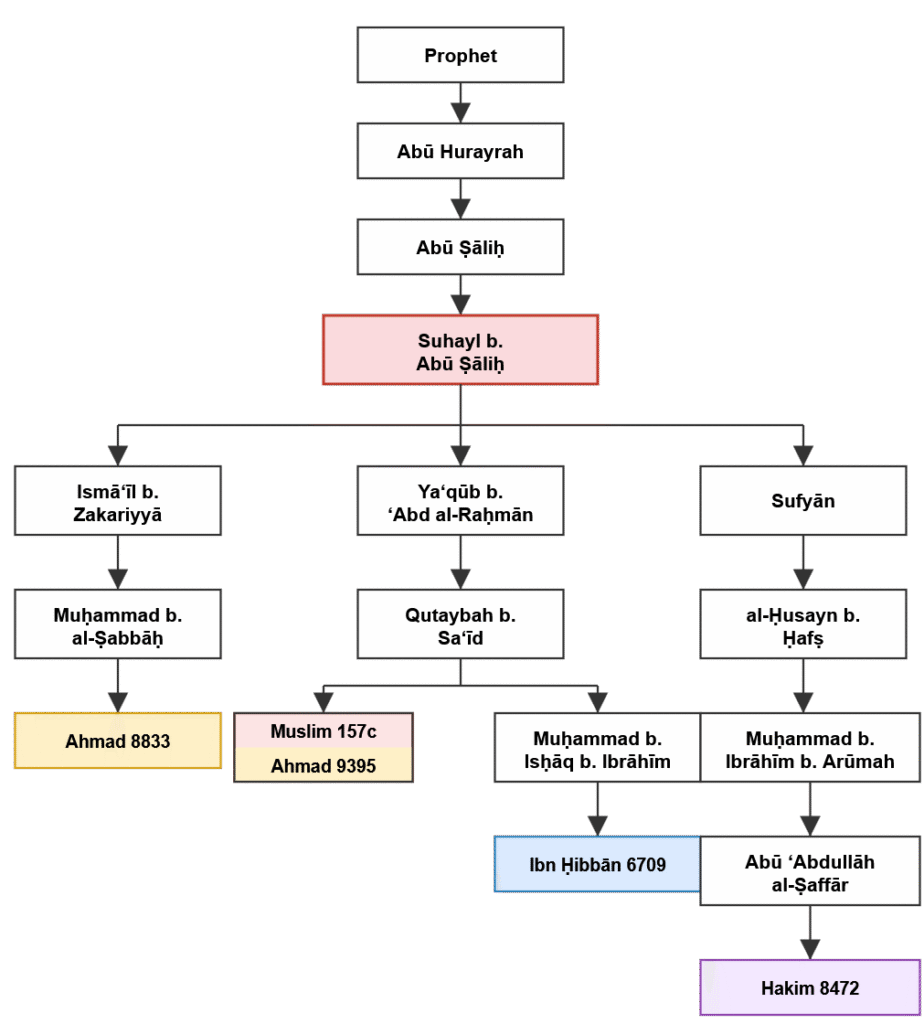
The hadith compilations preserve five predominant narrations, all containing the Arabia-returning-to-meadows-and-rivers motif, each tracing back to Suhayl through three branches:
Branch 1 — Via Yaʿqūb ibn ʿAbd al-Raḥmān: Three transmissions (Muslim 157c, Aḥmad 9395, Ibn Ḥibbān 6700) display significant textual variation. The shortest (Ibn Ḥibbān) contains only al-harj and the greening clause. Muslim 157c and Aḥmad 9395 add an overflowing-wealth clause. This suggests the greening prophecy circulated first as a standalone statement before being embedded in broader eschatological material.
Branch 2 — Via Ismāʿīl ibn Zakariyyā: Aḥmad 8833 opens with the greening clause, then uniquely adds a security prophecy about safe travel between Iraq and Mecca — entirely absent from Branch 1. As the only transmitter to include this, Ismāʿīl ibn Zakariyyā al-Kūfī (d. 161/778) appears to have localised the prophecy for his Iraqi audience. The Iraq-Mecca corridor was central to Umayyad pilgrimage control.
Branch 3 — Via Sufyān: Al-Ḥākim 8472 contains only the bare greening statement, but with this extraordinary caveat: lā aʿlamu illā qad rafaʿahu — “I do not know except that he raised it to the Prophet.” Major authorities like Sufyān rarely qualified chains with such explicit doubt about marfūʿ attribution unless they suspected dubious prophetic pedigree. Even among Suhayl’s own students, the statement’s true origin was unclear.
Umayyad Agricultural Revival in the Hijaz
The reign of Hishām ibn ʿAbd al-Malik (r. 724–743 CE) marked the height of Umayyad state intervention in land reclamation and irrigation. Archaeological and historical sources show a deliberate effort to “green” large tracts of the caliphate’s territory, linking agricultural revival to divine favour and political legitimacy. Marsham notes that under Hishām, the caliph opened up many water channels, established plantations in Mesopotamia and Syria, and formed part of a broader policy reclaiming uncultivated land and expanding the tax base.
In the Ḥijāz, these initiatives came at the expense of local ownership: the Hijaz’s local elites had to bear seeing their estates confiscated, bought up as distress sales, or otherwise infringed upon by members of the Umayyad family.
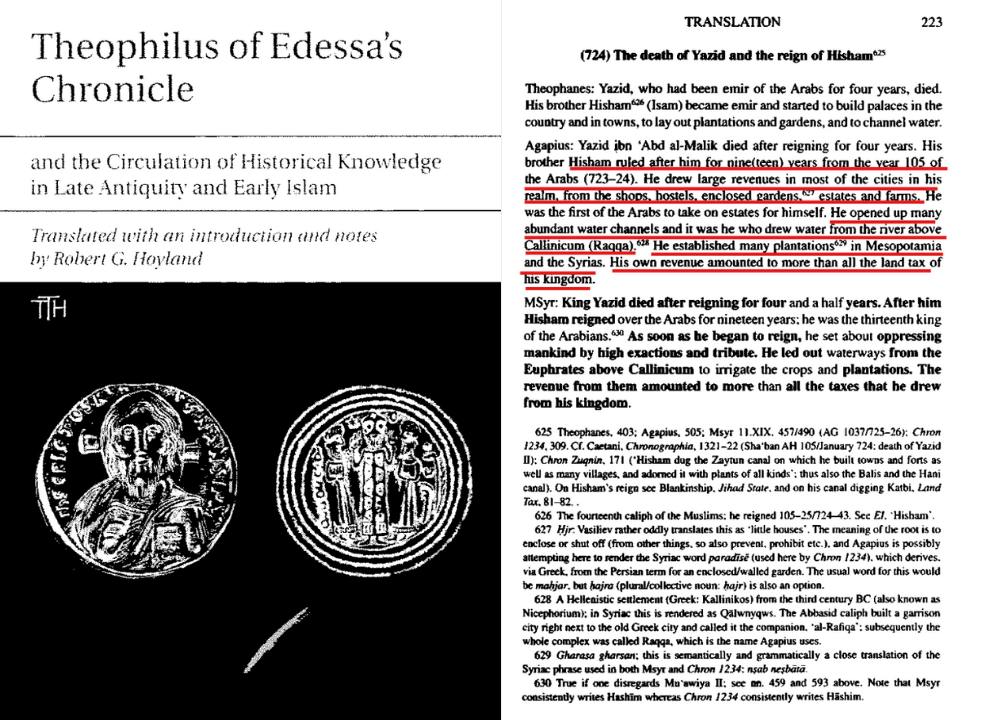
Robert G. Hoyland, trans., Theophilus of Edessa’s Chronicle (Liverpool: Liverpool University Press, 2011), 223.
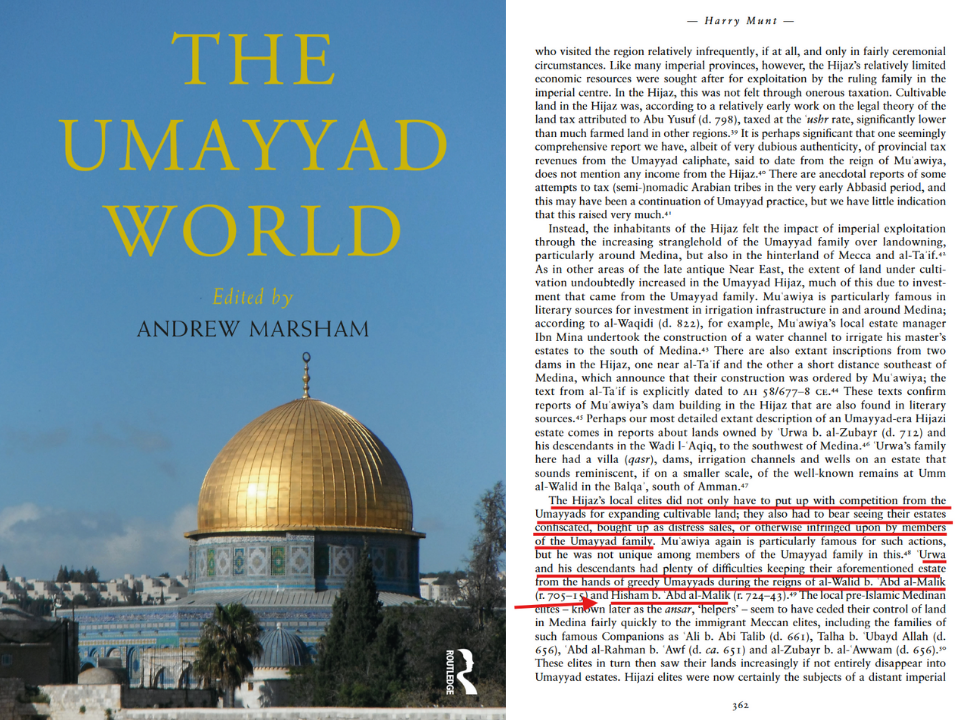
Andrew Marsham, ed., The Umayyad World (London: Routledge, 2021), 362.
Eger’s archaeological synthesis makes clear these projects were systematic: Umayyad elites developed abandoned or non-agricultural lands with irrigation systems and were rewarded with land ownership and tax exemptions. These were part of a coordinated administrative program that incentivized Umayyad elites to transform “dead land” (mawāt) into taxable estates.
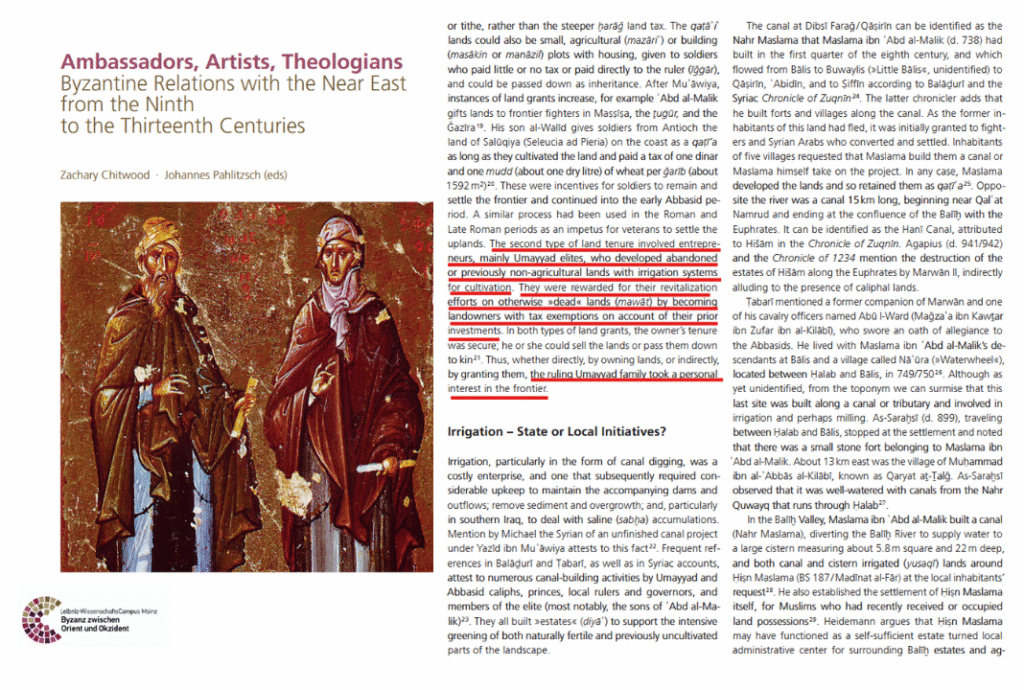
A. Asa Eger, “The Agricultural Landscape of the Umayyad North,” in Ambassadors, Artists, and Theologians, Byzanz Between Orient and Occident 12 (Mainz: RGZM, 2018), 20.
These policies were economically successful but socially divisive. To ease discontent, official discourse celebrated agricultural renewal as a sign of divine blessing — visible proof that God had “restored life to dead land.” Within this ideological atmosphere, a Medinan transmitter with Umayyad ties could easily reframe that political slogan as prophetic speech. The historical record thus situates the “land of Arabia returning to meadows and rivers” not in the Prophet’s era, but in the Umayyad project of agricultural revival.
Suhayl ibn Abī Ṣāliḥ and the Politics of Transmission
Suhayl ibn Abī Ṣāliḥ was a Medinan mawlā of the Ghatafān — one of the tribal blocs that had aligned early with Umayyad authority. The Ghatafān formed part of the broader Qays tribal confederation. Hishām’s administration is well known for favouring northern Arab (Qays) tribes after a long period of Yemenite dominance in Umayyad politics, relying on them for both military recruitment and provincial administration.
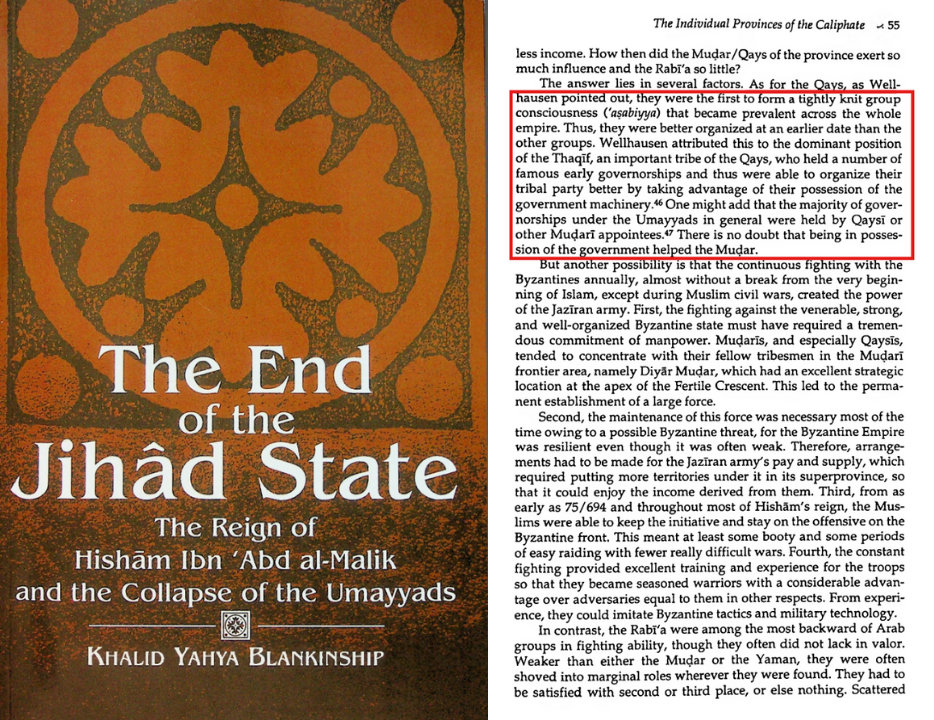
Khalid Yahya Blankinship, The End of the Jihad State (Albany: SUNY Press, 1994), 55.
Suhayl’s reliability was contested, especially in his later years. Classical rijāl critics record a pattern of memory deterioration and inconsistent narration:
Ibn Maʿīn: “He is not as good as others.”
Al-Nasāʾī: “His ḥadīth is not proof (ḥujjah).”
Abū Ḥātim: “His ḥadīth are written down, but not used as proof.”
Al-Dhahabī: “He may have been afflicted by forgetfulness in some of his ḥadīths.”
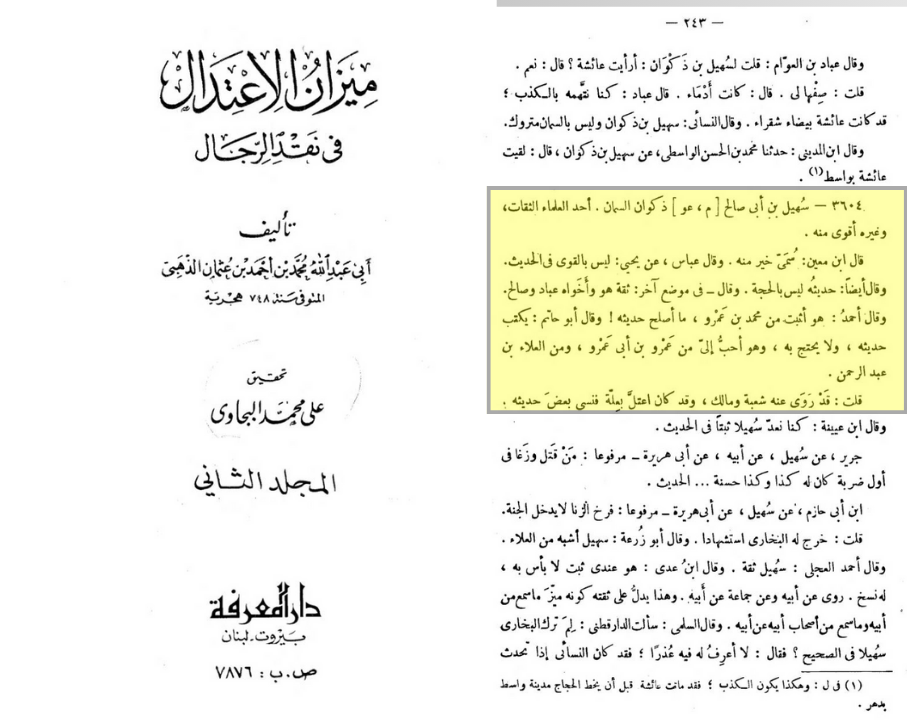
Al-Dhahabī, Mīzān al-iʿtidāl fī naqd al-rijāl, ed. ʿAlī Muḥammad al-Bijāwī (Beirut: Dār al-Maʿrifah, 1963), 2:243–44.
The “green Arabia” report is unique in being unverifiable through any independent parallel transmission. It survives only through Suhayl — making this a single-strand common link, the narrowest point of convergence in isnād-cum-matn methodology. Beyond technical weakness, Suhayl’s social position as a Medinan scholar under Umayyad oversight meant his livelihood and prestige depended on maintaining favour with state-aligned patrons. For such clients, hadiths affirming divine blessing upon the Arabian landscape and portraying agricultural renewal as eschatological fulfilment were ideologically convenient.
From Policy to Prophecy
As a Medinan transmitter aligned through his Ghatafān background with the Qays tribal bloc favoured under Hishām ibn ʿAbd al-Malik, Suhayl belonged to the very milieu that benefited from Umayyad patronage and land policies. His career unfolded at the exact time when the state needed religious language to legitimise unpopular agricultural projects in the Ḥijāz, and to pacify populations angered by Umayyad property seizures. The hadith’s eschatological frame allowed imperial reclamation policy to be reinterpreted as the inevitable fulfilment of a prophetic vision.
Suhayl may have sought to reconcile Medinan resentment over Umayyad land policy by recasting it as divinely ordained: “The Prophet said this would happen; submit to it.” The phrasing — the land of Arabia will return to meadows and rivers — invokes both nostalgia and inevitability. No earlier authority transmits it. No parallel route corroborates it. A transmitter explicitly hesitates over its marfūʿ status. The most economical historical explanation is that the report originated with Suhayl rather than the Prophet.
The isnād’s later diffusion reinforces this. Suhayl’s Medinan student Yaʿqūb ibn ʿAbd al-Raḥmān al-Qārī preserved the report and transmitted it onward to Qutaybah ibn Saʿīd, through whom it entered the canonical corpus of Ṣaḥīḥ Muslim and Ibn Ḥibbān. By the third century, the political context was forgotten. But the transmission profile points unmistakably back to one man, one setting, and one ideological moment: Medina under the Umayyads, when loyalty to the caliph could be expressed through words falsely placed upon the lips of the Prophet.
The Evidence Stacks Up
Let’s review the convergence of evidence:
1 — SINGLE TRANSMITTER
All versions trace exclusively to Suhayl. No independent verification exists anywhere in the corpus.
2 — SUSPECT TRANSMITTER
Suhayl had documented memory problems and inconsistent narration in his later years per multiple classical critics.
3 — EARLY DOUBTS
Even Suhayl’s own student Sufyān explicitly doubted whether this came from the Prophet.
4 — PERFECT TIMING
Appeared exactly when the Umayyads needed religious justification for unpopular agricultural projects.
5 — PERFECT MOTIVE
Suhayl belonged to a tribal group that benefited from Umayyad patronage and land-grant policies.
6 — PERFECT UTILITY
The hadith’s message directly supported Umayyad policy and helped suppress resistance to land confiscations.
This is textbook political hadith fabrication. The historical context, transmission profile, and ideological function all point to the same conclusion: this hadith was created in 8th-century Medina to legitimise Umayyad land policies, not spoken by Muhammad in the 7th century.
The Modern Cover-Up
Fast forward thirteen centuries. Muslims discover that ancient Arabia was once green. Someone digs up this old hadith and realises it could be marketed as a scientific miracle. There is just one problem.
The most widely used English translation of Sahih Muslim is by Abdul Hamid Siddiqui. If you look up his translation of this hadith on QuranX.com, here is what it says: “…till the land of Arabia BECOMES meadows and rivers.” Not “returns.” Not “reverts.” BECOMES.
This is a problem for the miracle claim. If it just says Arabia will “become” green, that’s mundane — humans have been irrigating deserts for thousands of years. But if it says Arabia will “revert” to being green, now you can claim Muhammad had special knowledge about palaeoclimate.
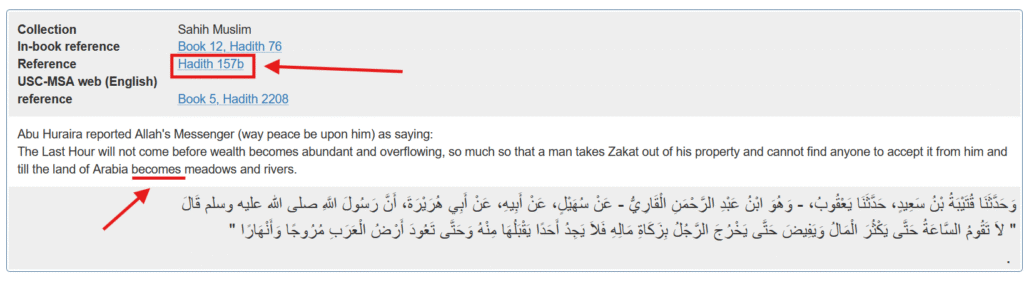
Siddiqui’s actual published work on QuranX.com — using ‘becomes‘ not ‘reverts‘.
The Arabic word تعود can mean either “become” or “return” — both are valid according to Lane’s Lexicon and Hans Wehr. Siddiqui chose “become.”
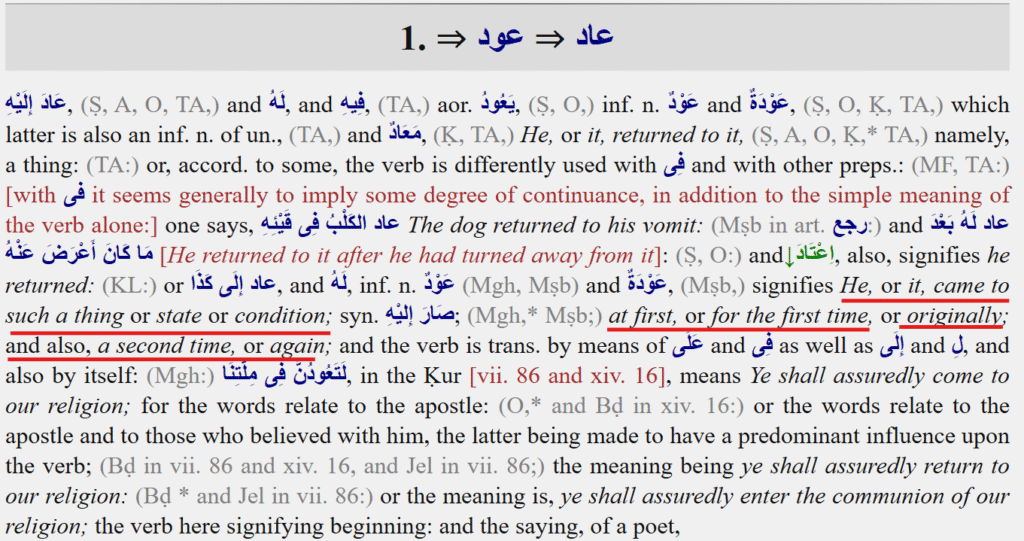
Lane’s Lexicon — عاد: both “to become” and “to return” are established meanings.
In 2019, IERA (Islamic Education and Research Academy) published Forbidden Prophecies by Abu Zakariya. The book promotes the Arabia hadith as key proof of Muhammad’s prophethood, explicitly claiming the word means “return” so Muhammad knew about ancient green Arabia.
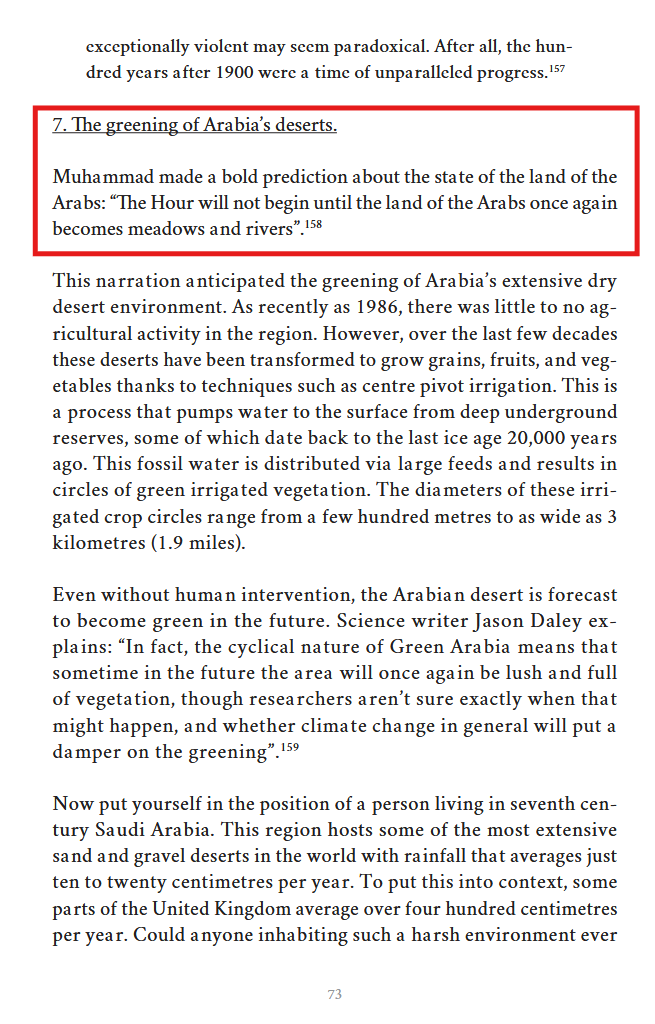
Forbidden Prophecies by Abu Zakariya (p. 73)
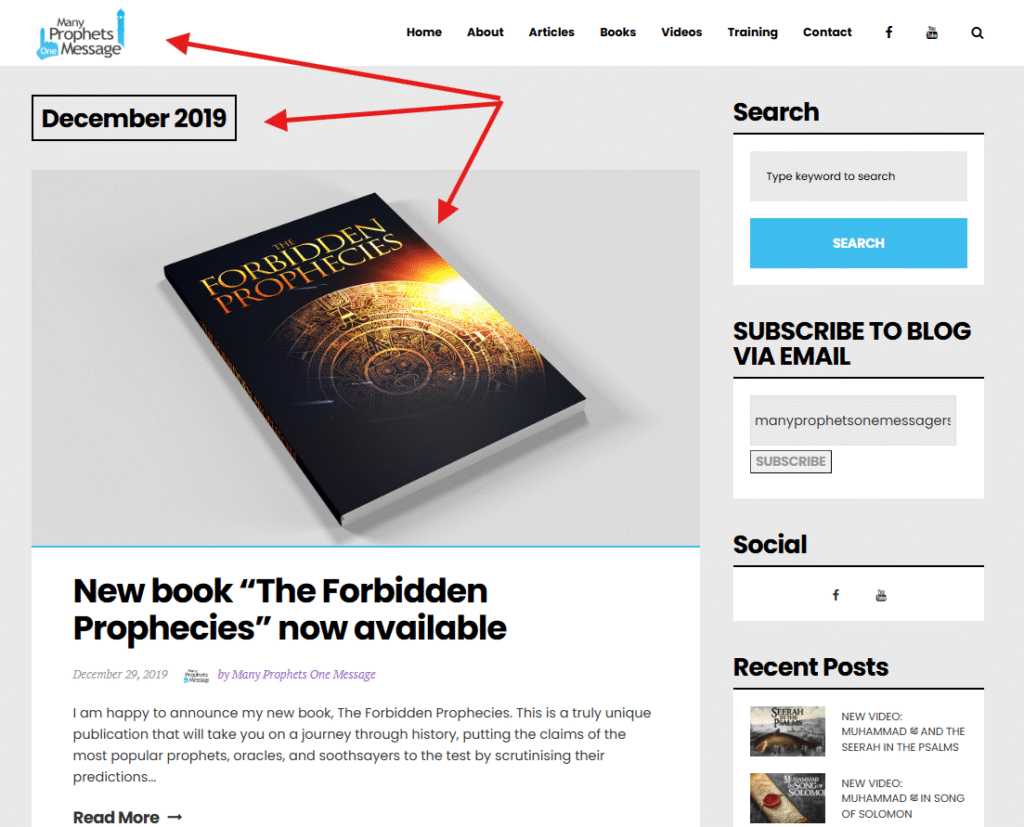
The book was officially announced on December 29, 2019. In January 2020, IERA uploaded a YouTube video promoting it as a “very powerful argument for the prophethood.” They started marketing it heavily in dawah circles. And then something suspicious happened.
The Complete Timeline: How the Deception Unfolded
DECEMBER 29, 2019
IERA officially announces Forbidden Prophecies on the Many Prophets One Message website. The book uses the Arabia hadith as proof of Muhammad’s divine knowledge, claiming the Arabic means “return” so Muhammad knew Arabia was green in ancient times. (source)
JANUARY 22, 2020
IERA uploads a YouTube lecture titled “The Forbidden Prophecies” promoting the book as a “very powerful argument for the prophethood” and encouraging orders. Active promotional campaign begins.
APRIL 8, 2020
Multiple X (Twitter) posts recommend the book in dawah contexts alongside Yaqeen Institute materials as essential reading for “prophecies and miracles in Islam.”
APRIL 28, 2020 — TWO EVENTS ON THE SAME DAY:
1. X user @justcarmi_ announces: “Guys, the Forbidden Prophecies book written by Abu Zakariya is now available in soft copy. You can download it for FREE.”
2. Wayback Machine captures Sunnah.com displaying Sahih Muslim 157b with Siddiqui’s translation: “the land of Arabia BECOMES meadows and rivers.”
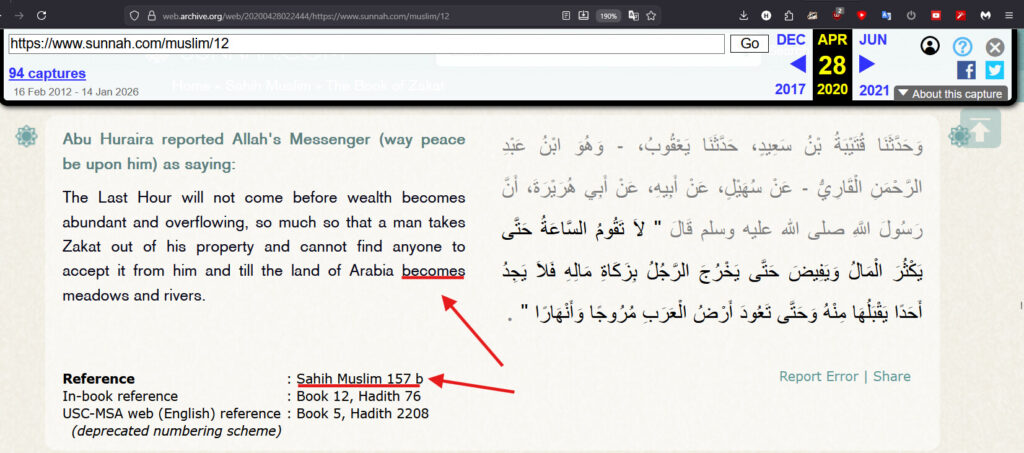
Wayback Machine capture — April 28, 2020: Sunnah.com still shows “BECOMES“
The free PDF spread rapidly through Muslim communities, especially during COVID-19 lockdowns. Muslims reading the book would naturally check Sunnah.com to verify the hadith. But when they looked, it said “becomes” not “reverts” — directly contradicting the book’s miracle claim.
MAY–JUNE 2020
Spike of X activity. @BrotherAlexP (May 29) recommends the book. @Yacerola (June 4) cites it as evidence for prophethood. @Smaasid (June 28) quotes directly from page 18 of the book, showing active engagement with its content.
JUNE 28, 2020 — TWO EVENTS ON THE SAME DAY:
1. @Smaasid quotes directly from the book’s content, confirming widespread active reading.
2. Wayback Machine captures Sunnah.com displaying: “the land of Arabia REVERTS to meadows and rivers.”
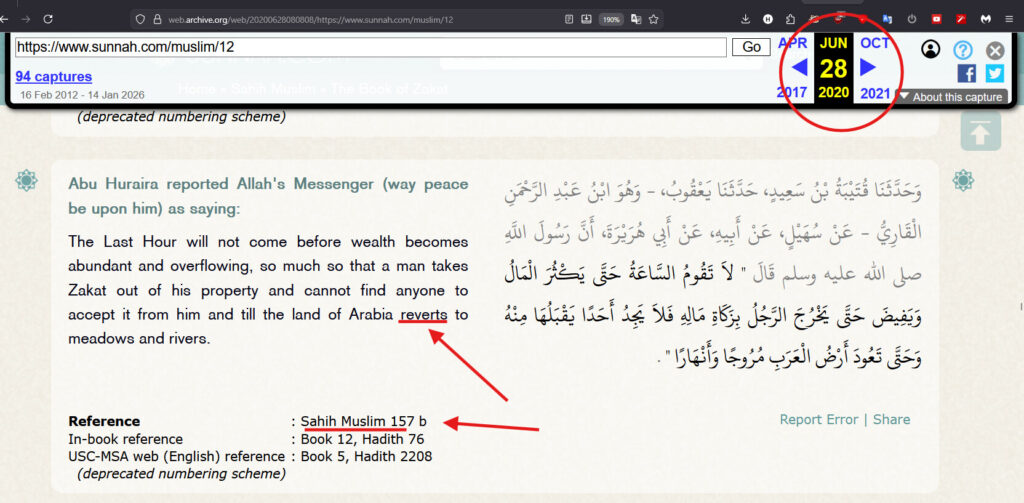
Wayback Machine capture — June 28, 2020: Sunnah.com now shows “REVERTS“
MARCH 2021
A Reddit post on r/exmuslim explicitly exposes the change, stating: “The last snapshot where they use the ‘become’ translation is in April 2020. The book Forbidden Prophecies was released in mid-2019, and it gained popularity in 2020. According to the snapshots, this is the very year that sunnah.com changed their translation from ‘become’ to ‘revert’, because they knew that people will be trying to fact-check this translation after reading the book!”
The Smoking Gun: A Reactionary Change
Between April 28 (when the free PDF became available) and June 28 (when people were actively discussing and quoting the book), Sunnah.com changed the translation. Precisely two months, during the exact spike in social media activity. The cluster of X posts from April to June shows the book gaining serious traction. Muslims reading it would check Sunnah.com to verify — and find a contradiction. Within two months of that pressure, the translation changed.
Only “becomes” was swapped for “reverts.” Nothing else changed. Not other words in the hadith. Not other hadiths in the collection. Just this one word — the one that directly supports the book’s argument about Muhammad predicting palaeoclimate. This was not a general translation update. This was targeted editing to support one specific miracle claim.
Sunnah.com claims to use Abdul Hamid Siddiqui’s translation. But Siddiqui’s actual published work says “becomes” — verifiable on QuranX.com. So Sunnah.com took Siddiqui’s translation, changed one key word, without switching translators or adding any explanatory note. IERA published Forbidden Prophecies. Sunnah.com is closely associated with IERA’s dawah network. This isn’t just suspicious timing. This looks like coordination.
Even if you accept this hadith as authentic, the “return to ancient greenery” interpretation still doesn’t hold up. When you read what classical Muslim scholars actually wrote about this hadith, none of them interpret it that way.
What Classical Scholars Actually Said
The scholars who knew Arabic and understood the historical context did not read this as a miraculous prediction about palaeoclimate:
Imam al-Nawawi — In his commentary on Sahih Muslim, Nawawi explains the hadith as referring to a future where wars cause depopulation. With fewer people, the land won’t be farmed or irrigated, so it will become wild and overgrown.
“Its meaning, and God knows best, is that they will abandon it and turn away from it, so it will remain neglected, neither cultivated nor irrigated from its waters. That will be due to the scarcity of men, the abundance of wars, the accumulation of tribulations, the nearness of the Hour.”
Al-Nawawi’s Commentary on Sahih Muslim
Al-Qurṭubī — He says the Arabs will stop fighting and start investing in agriculture, planting crops and building irrigation systems. No mention of returning to ancient conditions — just future human agricultural activity.
“The motivations of the Arabs will turn away from their customary pursuit of migration and warfare such that they withdraw from that and instead occupy themselves with planting the land, cultivating it, and channelling its waters, as has been observed in many of their lands.”
Al-Qurṭubī’s commentary
Ibn Uthaymeen — Even the modern scholar Ibn Uthaymeen prefers the “become” interpretation rather than “return”: “Until it becomes meadows and rivers. The meadows are gardens and farms. Rivers are the waters that flow on the surface of the earth. If we look at our reality today, we find that the second part of the hadith has occurred.” He describes artesian wells and modern irrigation — not a miraculous palaeoclimate prediction.
Three different classical and modern scholars, all reading “become” / future agricultural development — none reading “revert to ancient green conditions.” The “palaeoclimate miracle” interpretation was invented in the 21st century, not recognised by any classical authority.
Hadith Wording Is Not Fixed
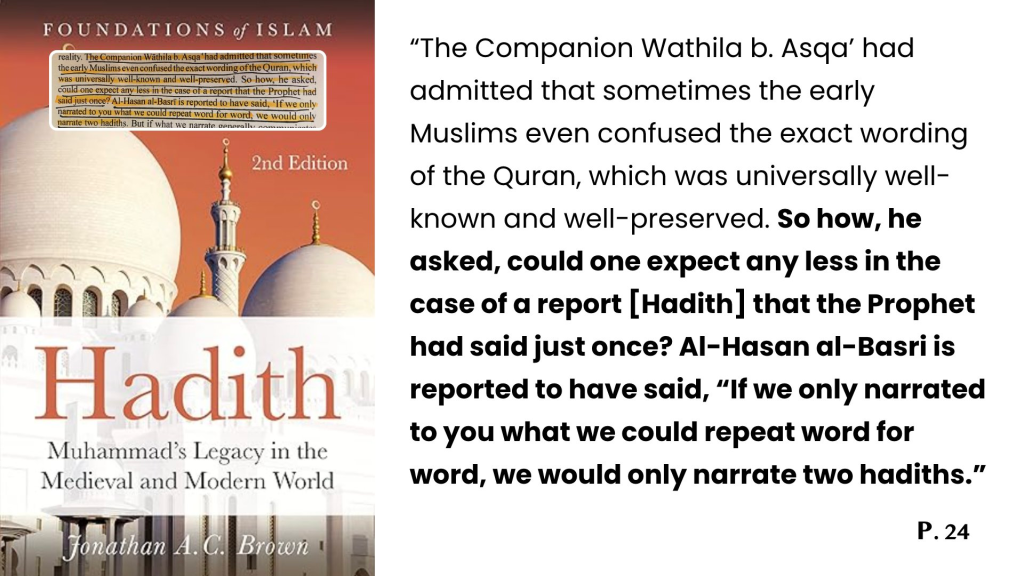
Unlike the Quran, hadith were never transmitted word-for-word. Muslim scholars have always acknowledged this — it is called narration by meaning (riwāya bil-maʿnā). Imam al-Nawawi wrote that the majority of early scholars agreed it was permissible to narrate hadith in your own words. Jonathan Brown explains that Muslim scholars allowed hadith to be paraphrased as long as the narrator understood the meaning.
To illustrate how real this is: there is a hadith about a man who wanted to marry but had no dowry. In different narrations, Muhammad’s response is recorded using completely different Arabic verbs for “married” — not slight variations but fundamentally different words:
| # | COLLECTION | ARABIC | ENGLISH | CATEGORY |
|---|---|---|---|---|
| 1 | Bukhārī 5030 | زَوَّجْتُكَهَا | I married you to her | Marriage contract |
| 2–3 | Bukhārī 5087, 5126 | مَلَّكْتُكَهَا | I made you possess her | Property transfer |
| 5 | Muslim 1425b | أَنْكَحْتُكَهَا | I wed you to her | Marriage contract |
| 8 | Al-Bayhaqī 13823 | وَهَبْتُكَهَا | I gifted her to you | Gifting |
| 9 | Al-Bayhaqī 14359 | خُذْهَا | Take her | Command |
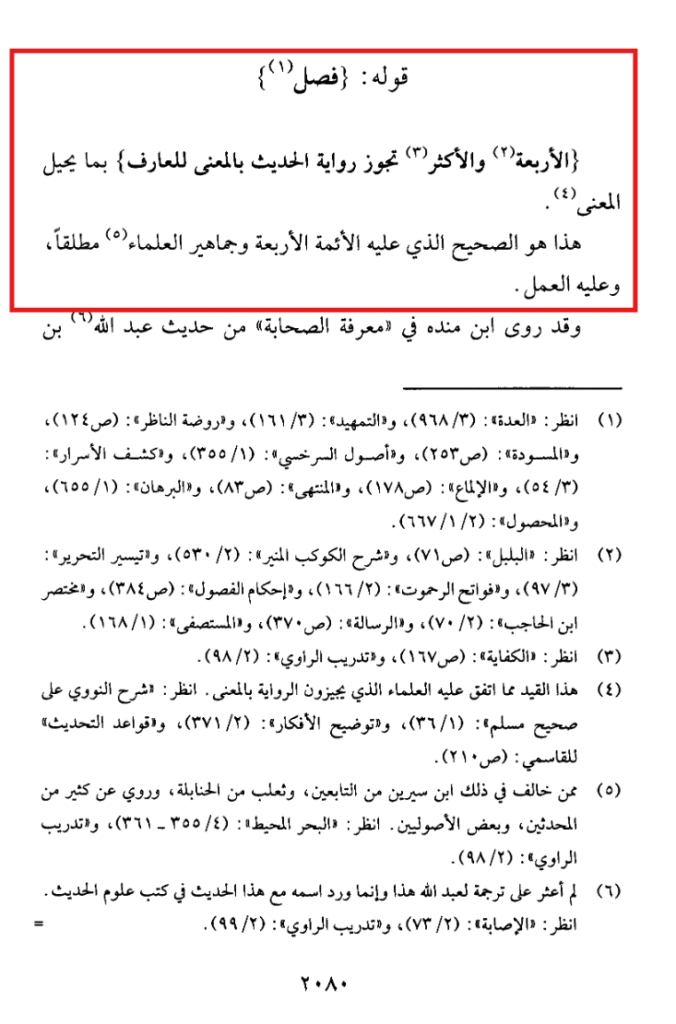
Al-Taḥbīr sharḥ al-Taḥrīr fī uṣūl al-fiqh — ʿAlāʾ al-Dīn al-Mardāwī (885 AH): the four Imams and the majority of scholars permitted narrating hadith by meaning.
These are not synonyms with subtle shades of meaning — they represent fundamentally different concepts: legal contract terms, property transfer, gifting, command. One expression, one story, multiple completely different words. If that hadith’s wording cannot be pinned down, how can Muslims insist Muhammad definitively said تعود in the Arabia hadith?
Final Verdict
The evidence is overwhelming on both fronts. The hadith was almost certainly created in 8th-century Medina by Suhayl ibn Abī Ṣāliḥ to legitimise Umayyad agricultural projects and land seizures. Every version traces exclusively to him. Classical critics flagged his memory problems. His own student doubted the prophetic attribution. His tribal ties to the Qays confederation gave him direct connections to the Umayyad power structure. And he lived and taught in Medina precisely during Hishām’s irrigation and land-reclamation campaigns — exactly when and where a hadith glorifying a greening Arabia would serve clear political purposes.
Centuries later, Muslims try to resurrect this fabrication as a scientific miracle. When the translation doesn’t support their claim, they change it. We have social media evidence showing the book’s popularity spiking in April–June 2020. We have Wayback Machine screenshots proving Sunnah.com made the change during this exact window. Siddiqui’s original published translations clearly show the intended wording. Classical commentaries demonstrate that no scholar ever interpreted it as a palaeoclimate miracle.
This is dishonesty layered on top of dishonesty. A fabricated hadith from the 8th century gets reinterpreted in the 21st century, and when the translation doesn’t support the reinterpretation, they change the translation. The pattern shows up across Islamic miracle claims: take an ambiguous text, reinterpret it in light of modern discoveries, bend the language to fit, ignore what classical scholars said, pretend the interpretation was always obvious. When websites actively participate by changing translations, they cross from interpretation to manipulation. They are not offering a different perspective. They are manufacturing evidence.