The Fabricated Baghdad Hadith Prophecy
More Evidence Against Saʿīd ibn Jumhān
How a traumatized Basran narrator repackaged his city’s suffering as divine prophecy — and why the apologetic defence of it fails.
The Controversy
In January 2025, I published “Fabricated Hadith Prophecy: The Siege of Baghdad,” which demonstrated through historical analysis that a widely cited hadith allegedly predicting the Mongol invasion was actually fabricated in the 2nd century AH. The article included an isnad diagram I created to illustrate how all transmission chains converged at a single Basran narrator, Saʿīd ibn Jumhān, who transformed a non-prophetic statement into alleged divine revelation.
Recently, TheOrthodoxMuslim released a video titled “Proving Islam In 7 Minutes” using my diagram to argue the opposite conclusion — that the hadith’s multiple chains prove its authenticity. The irony is that he used research demonstrating fabrication to claim authenticity. Christian apologist RobChristian subsequently released a response exposing these distortions.
This situation exemplifies a problem that Islamic hadith scholars identified over a millennium ago. Yaḥyá ibn Saʿīd al-Qaṭṭān (d. 198/813), a prominent Basran hadith critic who dedicated himself to identifying unreliable transmitters, reportedly observed: “I have not seen the pious, in any regard, more dishonest than they are in regard to Hadith.” As Dr. Joshua Little’s Isnad-Cum-Matn-Analysis demonstrates, this statement likely traces to Yaḥyá himself — a candid admission that well-intentioned believers were often the worst offenders in hadith fabrication.
What makes TheOrthodoxMuslim’s case particularly troubling is not mere disagreement over methodology, but the demonstrable distortion of source material he accessed. In classical hadith criticism, a transmitter who knowingly misrepresents information from his source would be deemed unreliable at best, a fabricator at worst.
Since publishing the original article, I have conducted additional research that further strengthens the case against this narration’s authenticity. Before presenting new findings, I will recap the January research for those unfamiliar with the controversy.
Summary of January 2025 Research
Modern hadith apologists argue that Muhammad predicted with remarkable specificity the following events — and that their fulfilment in the Mongol sack of Baghdad in 1258 CE, approximately 640 years later, constitutes proof of prophecy:
The Claimed Prophecy:
- A major Muslim capital called “al-Basra” would emerge near the Tigris River with a bridge
- Its inhabitants would be numerous
- Descendants of Qanṭūrā — with broad faces and small eyes — would attack it
- The population would divide into three groups with distinct fates: one fleeing and perishing, one seeking safety but dying or disbelieving, one fighting to martyrdom
- Fulfilled, apologists claim, by the Mongol destruction of Baghdad in 1258 CE
The full original research is available here. What follows is a condensed recap of its core findings, followed by new material that further illuminates Saʿīd ibn Jumhān’s motivations and methods.
The Earliest Versions Are Not Prophetic
The earliest attestations do not trace to Muhammad at all. In ʿAbd al-Razzāq’s Muṣannaf (#20799), transmitted through the highly reliable Muḥammad ibn Sīrīn (d. 110 AH), we find a statement attributed not to the Prophet but to the Companion ʿAbdullāh ibn ʿAmr ibn al-ʿĀṣ:
“The Banū Qanṭūrā are about to drive you out from the land of Iraq.” I asked, “Then shall we return?” He replied, “That is more beloved to you. Then you shall return, and there will be for you therein a pleasant life.”
ʿAbd al-Razzāq, Muṣannaf #20799 — attributed to ʿAbdullāh ibn ʿAmr ibn al-ʿĀṣ, not the Prophet
This is ʿAbdullāh ibn ʿAmr’s personal statement — not a prophetic hadith. There is no chain to Muhammad. No claim of revelation. The statement reflects his own assessment, drawing on sources he himself identified elsewhere.
ʿAbdullāh’s Explicit Biblical Source
In Ibn Abī Shaybah’s Muṣannaf (#38400), when asked who the Banū Qanṭūrā were, ʿAbdullāh ibn ʿAmr explicitly names his source:
“As for in the Book? That is how we find it. And as for the description? They are the description of the Turks.”
Ibn Abī Shaybah, Muṣannaf #38400
“The Book” (al-Kitāb) refers to Biblical scripture — specifically Genesis 25:1–4, where Abraham takes a wife named Keturah (Hebrew: קְטוּרָה / Arabic: قَنْطُورَا), who bears him six sons whom Abraham “sent away to the east country.” Later Islamic scholars like al-Qurṭubī (d. 1273 CE) explicitly identified Keturah’s descendants with the Turks.
ʿAbdullāh ibn ʿAmr was well known for collecting Jewish and Christian traditions. Ṣaḥīḥ al-Bukhārī (#3461) records him narrating that the Prophet said: “Narrate from the Children of Israel; there is no harm.” He was doing exactly that — applying Biblical eschatology to contemporary Basran concerns. This is not prophecy. It is a Companion recycling Israelite scripture.
Saʿīd ibn Jumhān: The Common Link
When we diagram the transmission chains of all later “prophetic” versions, every single chain converges at one person: Saʿīd ibn Jumhān, a Basran narrator who died in 136 AH. Before Saʿīd, we have ʿAbdullāh ibn ʿAmr’s non-prophetic statement citing Biblical sources. After Saʿīd, we suddenly have a detailed “prophetic hadith” with added elements: specific physical descriptions of the invaders, the three-groups structure with theological implications, and details mirroring the Khārijī attacks on Basra during Saʿīd’s own lifetime.
The Core Transmission Problem: Every independent-looking chain in the corpus traces to the same point. TheOrthodoxMuslim presented this as multiple independent witnesses confirming the report. It is the opposite — it is the textbook pattern of a single fabricator whose invention spread outward. Multiple later transmitters sharing one source is not corroboration. It is a common-link signature.
Classical critics raised concerns about Saʿīd directly:
Al-Bukhārī: “His narrations contain ʿajāʾib — strange, anomalous reports.”
Abū Ḥātim al-Rāzī: “Truthful but not reliable enough for primary evidence.”
Al-Ṣājī: “His narrations are not corroborated.”
Moreover, Saʿīd couldn’t maintain consistency in his own chain. He variously claims to have received this report from Muslim ibn Abī Bakrah, ʿAbdullāh ibn Abī Bakrah, or simply “a son of Abū Bakrah” without specification. This inconsistency in identifying his immediate source is a classic fabrication indicator — a narrator who genuinely heard something from a specific person remembers who that person was.
Continuous Reinterpretation
The interpretation of “Banū Qanṭūrā” shifted repeatedly across nine centuries to fit whatever crisis was current. If this were a genuine prophecy with specific details, why did scholars far closer to Muhammad understand it to refer to entirely different peoples and events?
8TH CENTURY
ʿAbdullāh ibn ʿAmr identifies Banū Qanṭūrā as Turks threatening Basra — sourced from Biblical scripture
9TH CENTURY (884 CE)
Ibn al-Munādī applies it to the Zanj rebellion — East African slaves attacking Basra
10TH–12TH CENTURIES
Applied to Turkic slave soldiers causing Abbasid political instability
POST-1258 CE
Retrospectively applied to the Mongols destroying Baghdad — the modern apologetic reading
17TH CENTURY
Al-Dihlawī (d. 1642 CE) explicitly identifies it with the Mongol invasion of Baghdad
A prophecy specific enough to identify a city, a bridge, a river, and a three-way division of the population does not require five successive reidentifications across nine centuries. The pattern of reinterpretation is itself evidence of post-hoc rationalisation — each generation finding its own crisis in language vague enough to accommodate any army approaching from the east.
The Hadith Names Basra, Not Baghdad
The narration explicitly states “al-Basra” — a city 550 kilometres south of Baghdad. The geographic description within the hadith itself matches Basra: low-lying terrain, palm trees, flooding-prone land beside the Tigris, a strategic bridge. None of this describes Baghdad.
Apologists offer two responses. First: that Baghdad had a district called “Bāb al-Baṣra” (the Basra Gate). Second: that “al-Basra” was used loosely to mean the entire lower Iraq region. Neither claim is supported by primary sources. Both are post-hoc rationalisations made necessary by the geographic mismatch between the hadith and the event it is supposed to have predicted.
Baghdad was founded in 762 CE — over a century after Saʿīd ibn Jumhān’s death in 136 AH / 753 CE. Saʿīd could not have been writing about Baghdad. He was writing about the city he knew, had lived in, and whose siege by the Azāriqa Khārijites had killed his own father.
New Research: Saʿīd ibn Jumhān’s Historical Context
When we examine Saʿīd ibn Jumhān’s life circumstances, the origins of this fabricated prophecy become transparently clear. Saʿīd lived and died in Basra (d. 136 AH / 753 CE), a city repeatedly traumatised by Khārijite uprisings — particularly by the extremist faction known as the Azāriqa. His lifetime overlapped precisely with the height of their terror in southern Iraq. And his personal history reveals deep animosity toward the Khārijites rooted not in abstract theology, but in family tragedy.
In al-Ḥākim’s al-Mustadrak (#6435), Saʿīd recounts a meeting with the Companion ʿAbd Allāh ibn Abī Awfá:
“I said to Ibn Abī Awfá: ‘My father was killed by the Azāriqa.’ He replied: ‘May God curse the Azāriqa. The Messenger of God informed us that they are the dogs of Hellfire.'”
Al-Ḥākim, al-Mustadrak #6435
This is not incidental biographical colour. Saʿīd’s father was murdered by the very faction whose attacks on Basra he would later encode in his “prophetic” narration. His hatred of the Azāriqa was not abstract — it was the grief of a son. He expressed the same hostility in another surviving source. In al-Tirmidhī (#2226), after narrating the hadith on the thirty-year caliphate, Saʿīd appends his own editorial outburst:
“Banū al-Zarqāʾ have lied! They are kings — among the worst of kings.”
Al-Tirmidhī #2226 — Saʿīd’s own editorial comment appended to a hadith
By the second century AH, Saʿīd had developed a fiercely anti-Khārijite worldview shaped by Basran political realities and personal trauma. In the decades leading up to his death, Basra was repeatedly attacked and occupied by Khārijite rebels. Both al-Ṭabarī and Ibn Miskawayh record that during the Azāriqa insurrection, Nāfiʿ ibn al-Azraq advanced on Basra from the east bank of the Tigris — precisely the geographic setting described in Saʿīd’s fabricated prophecy.
From Ibn Miskawayh’s Tajārib al-Umam (2/130):
“In these days the power of the Khārijites in Basra increased, and Nāfiʿ ibn al-Azraq was killed. The reason for their rise: the Basrans were distracted by tribal disputes among Azd, Rabīʿa, and Tamīm … Nāfiʿ advanced until he approached the bridge (al-jisr), so ʿAbd Allāh ibn al-Ḥārith sent Muslim ibn ʿUbaysa against him; the two sides prepared for battle and confronted each other.”
Ibn Miskawayh, Tajārib al-Umam 2/130
Al-Ṭabarī similarly records the Khārijites positioning themselves on the east bank of the Tigris during their assault on Basra. The setting in the historical sources and the setting in Saʿīd’s narration are the same city, the same river, the same bridge.
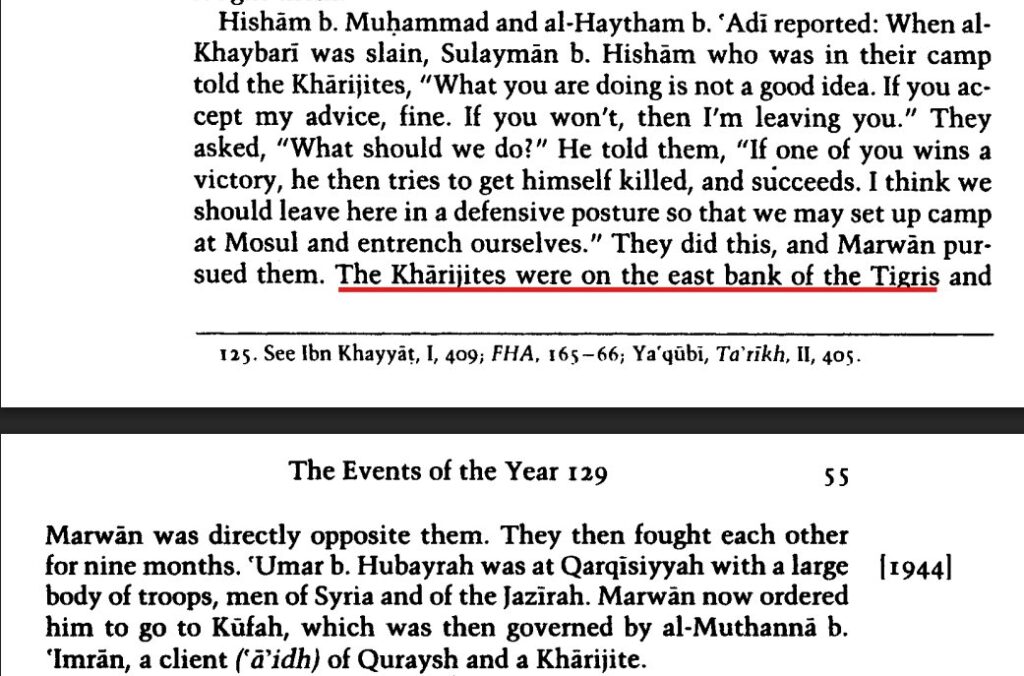
The Historical Correspondence
The correspondence between what al-Ṭabarī and Ibn Miskawayh record of the Azāriqa siege and what Saʿīd’s narration describes is not approximate — it is structural. Every element of the “prophecy” maps onto a documented historical reality from Saʿīd’s Basra:
| HISTORICAL REALITY (al-Ṭabarī / Ibn Miskawayh) | CORRESPONDING ELEMENT IN SAʿĪD’S NARRATION |
|---|---|
| Basra attacked by the Azāriqa Khārijites from the east bank of the Tigris | A city called al-Basra by the Tigris; invaders advance and camp by the riverbank |
| Nāfiʿ ibn al-Azraq advanced until he approached al-jisr (the bridge) | The city is specifically described as having a bridge over the Tigris |
| Basrans internally divided by tribal disputes among Azd, Rabīʿa, and Tamīm — three distinct groups | The people of the city divide into three groups, each with a distinct fate |
| Some factions withdrew or fled during the siege | One group flees and perishes |
| Others sought safety in collaboration or inaction | One group seeks safety and perishes — or kafaru (the Khārijite term for those they deemed apostates) |
| A portion of Basrans fought and died resisting the Khārijites | One group fights to martyrdom — religiously valorised |
| The city suffered major communal trauma and loss | Total losses implied across all three groups; no group escapes destruction |
What historians describe as the outcome of the Azāriqa siege becomes, in Saʿīd’s telling, a divinely foretold destiny. The historical trauma Basra experienced is repackaged as prophecy — complete with theological interpretations that delegitimise the Khārijites (calling them kafiru, apostates) and valorise those who resisted them (martyrs). The narrative serves an obvious polemical function in Saʿīd’s historical context, making it explicable why it was invented.
This explains the full constellation of evidence: why every element of the prophecy matches Basran realities from Saʿīd’s lifetime; why the narration only acquires prophetic attribution after Saʿīd; why earlier versions from ʿAbdullāh ibn ʿAmr contain none of these specific structural details; why Saʿīd fabricates a chain through Basran transmitters (Abū Bakrah and his son) to confer local credibility; and why classical hadith critics flagged his narrations as anomalous and uncorroborated.
Final Verdict
The “Siege of Baghdad prophecy” is the Siege of Basra experience. It was a traumatised Basran scholar — whose father was murdered by the Azāriqa, who watched his city attacked from the east bank of his Tigris — transforming recent history into prophetic revelation to delegitimise the Khārijites and valorise Basran resistance. The hadith is not a prediction. It is a memorial.
TheOrthodoxMuslim’s use of an isnad diagram created specifically to demonstrate this fabrication as evidence of the hadith’s authenticity is not a disagreement over method. It is a misrepresentation of the research he cited. In the terms of the very tradition he appeals to: a transmitter who knowingly distorts his source material is not a reliable witness.
The new evidence presented here — Saʿīd’s own testimony about his father’s murder by the Azāriqa, his documented anti-Khārijite polemics inserted into other hadiths, the precise structural mapping between the Azāriqa siege and every element of the “prophecy” — does not merely support the January conclusion. It explains why the fabrication took the specific form it did, and who had both the motive and the means to produce it.